
SOIL SCOUT WIRELESS SOIL SENSORS
Soil Scout wireless soil sensors, buried in the rootzone, report every hour.

A REAL-TIME MAP OF WHAT HAPPENS UNDERGROUND
Soil Scout is a fully buried soil sensor system. Place any number of wireless sensors in an area and get a complete, real-time underground map in the palm of your hand.
Used by professionals in:
HOW IT WORKS

Buried sensors read moisture, temperature and electrical conductivity, or oxygen, and transmit every hour.
The antenna picks up the signal and sends it to the server through a cellular modem.
You see the field online, get alarms by email and act zone by zone.
MAIN BENEFITS
Sensors placed anywhere across the field, with an online view of soil conditions for timely, informed decisions.
Know soil moisture before, during and after irrigation to save water and money and build an accurate irrigation strategy.
Designed so that even non-technical users get insights easily.
Small, maintenance-free sensors with a battery that lasts up to 20 years, measuring moisture, temperature and electrical conductivity.
Act on the insights to build soil resilience in a changing climate and get better long-term results.
Decisions based on accurate information instead of intuition or outdated methods.
Smart sensor placement shows the real differences across the field, so each zone is treated on its own.
Spot unfavorable conditions early and learn which conditions triggered problems, so practices get more proactive.
HARDWARE & SOFTWARE

A small, robust wireless sensor that transmits data from up to two meters below ground every hour, with a battery that lasts up to 20 years.
- Moisture
- Temperature
- Electrical conductivity
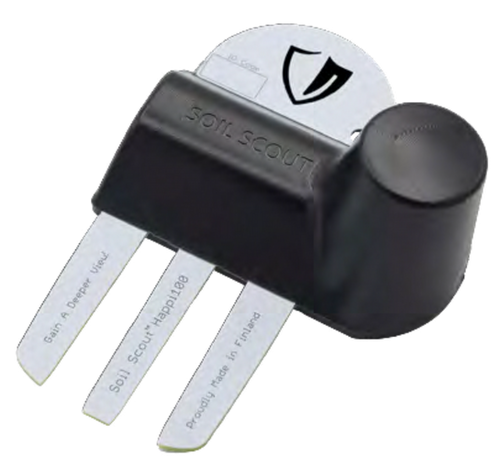
A buried wireless sensor that goes further and measures the oxygen level of your turf.
- Moisture
- Temperature
- Oxygen

The server validates the data and applies correction equations. The interface makes analysis easy and manages the equipment, with email alarms and data export through a Web Service API.
- Data validation
- Alarms and notifications
- API export

Receives the Scouts through an antenna and sends data to the Hub by cellular modem. Usually mounted on a pole or building.
- Antenna chosen per site
- Cellular modem

Solar-powered repeater that retransmits the signal when distance or terrain blocks the Base Station.
- Solar powered
- Line of sight

SOIL OXYGEN
A buried sensor that measures soil oxygen in real time.
Healthy roots are the foundation of strong plants. Soil oxygen is critical to keep roots healthy, and the Happi 100 measures it in real time.
THE BENEFITS OF OXYGEN MEASUREMENT
- Prevent root hypoxia. When soil oxygen starts to drop, you can plan and perform maintenance.
- Better drainage insights. Find the areas that drain poorly and focus interventions like aeration there.
- Increase nutrient uptake. Healthy subsoil oxygen is essential for plants to absorb nutrients.
- Adapt to field variations. Oxygen and moisture change across and within fields, so irrigation and aeration need to be tailored.
- Precision aeration. Aerate the areas that need it instead of the whole field.
- Avoid over irrigation. See oxygen during rain or irrigation and avoid saturation.
- Faster recovery. Well-drained areas recover oxygen in 1 day, poorly drained areas can take up to 7. Monitoring means timely interventions.
- Maximize playability. Selective aeration keeps more of the surface open, with fewer closures and lower labor costs.
WHAT IT CHANGES ON A SPORTS FIELD
Keep more of the playing surface open by avoiding unnecessary closures for maintenance.
Targeted maintenance saves on aeration, labor and fuel, reducing operating expenses.
Healthier roots with the right oxygen levels give more resilient surfaces that stay green and lush longer.
FREQUENTLY ASKED QUESTIONS
What is Soil Scout?
A fully buried wireless soil sensor system. You place any number of sensors in an area and get a complete, real-time underground map of moisture, temperature, electrical conductivity and, with the Happi 100, soil oxygen, on your phone.
How does the system work?
Buried Scout sensors take readings and transmit every hour. A Base Station picks up the signal with an antenna and sends it to the Soil Scout Hub through a cellular modem. In the Hub you see the field online, get alarms by email and export data through an API. Where distance or terrain blocks the signal, a solar-powered Echo Repeater retransmits it.
How long does the sensor battery last?
Up to 20 years. The Scout sensor is small, robust and maintenance-free, and transmits from up to two meters below ground.
Why measure soil oxygen?
Soil oxygen is critical to keep roots healthy. Measuring it helps prevent root hypoxia, shows which areas drain poorly, avoids over irrigation and lets you aerate only where oxygen drops. Well-drained areas recover oxygen in about 1 day; poorly drained areas can take up to 7.
Where can Soil Scout be used?
On golf greens and fairways, sports fields such as soccer and baseball, municipal parks, equestrian tracks and arenas, farms and orchards, and any other irrigated area.
TALK TO OUR EXPERTS
Tell us about your field and how you irrigate today. We will recommend where the sensors go.
Talk to our experts →